
Jeffrey C. Nesbitt
The Word of God proclaims that salvation is by
God's grace alone. Most professing Christians today will unreservedly avow
that they too believe that salvation is by “grace alone”. And
that’s a good thing. However, there is reason to believe that the
theology that is embraced by the vast majority of those who affirm
the Reformation doctrine of “Sola
Gratia” is antithetical to the biblical truth; “Salvation
is of the Lord.” (Jonah 2:9). What follows is a graphical representation
of the understanding of the doctrine of salvation held by most Evangelicals
today. It is hoped that this will aid many to think seriously about
what they believe, at least intellectually, and realize that it
does not represent in actuality the truth that “Salvation is of
the Lord God; by His grace alone!”
|
Key to the Diagram Below The "triangle" represents
the Triune God: Father, Son, and Holy Spirit. The Popular Evangelical View What does each of the three persons of the Trinity contribute to salvation? 1. The Father “Loves” all
mankind. 2. The Son “Died” for all
mankind. 3. The Holy Spirit “Draws”
all men. |
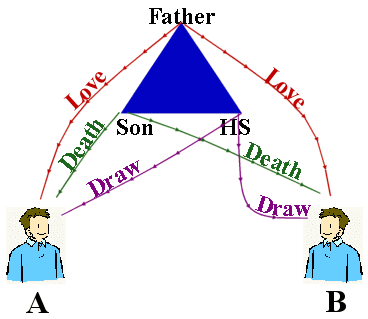
Let’s summarize the popular Evangelical view illustrated by the diagram above.
- The Father extends His everlasting love to all mankind without distinction. He loves no one more than anyone else. Those who are unsaved and destined to everlasting punishment are loved in the same manner and no less than those who are saved and destined to everlasting glory.
- The Son died in behalf of all mankind. He suffered the penalty due to all, thus everyone’s debt is paid in full. The death of Christ is both sufficient and efficient for all.
- The Holy Spirit comes to all men and provides the influence or drawing which is necessary to come to Christ for salvation. This wooing is given to all mankind without distinction.
So what is wrong with this view?
If the Father loves all mankind; all those who will remain unsaved (represented by “A”) just as much as those who are saved, (represented by “B”) . . .
If the Son died for all mankind; paying the penalty for the sins of those who will never be saved (represented by “A”) and those who will be saved (represented by “B”) . . .
If the Holy Spirit draws all men; giving the necessary influence to come to Christ to those who will be damned (represented by “A”) as well as to those who will be saved (represented by “B”) . . .
This then brings forth the question: If salvation is by grace alone, Why are not all men saved?
Evangelicals will answer: Because of unbelief! Not all men accept Jesus as their Saviour. While we agree, that not all men will repent and believe upon Christ unto their salvation, the question remains unanswered. If it is the grace of God that saves, why are those represented by “A”, those who will not be saved, not saved? We really need to press this question further so as to uncover the fundamental problem with this theology of “grace” as espoused by the modern Evangelical view.
- Since the love of God is bestowed upon all men; “A” as much as “B”, then it cannot be that this love actually saves. It is necessary to be sure, but just as certain it is not efficacious unto salvation, since all are recipients of the love of God yet one group remains unsaved.
- Since death of Christ is for all men; “A” as much as “B”, then it cannot be that this death actually saves. That Christ should pay the penalty due and make satisfaction for the debt owed is surely necessary, for without the shedding of blood there is no remission of sins. Yet there are multitudes for whom Christ died, according to this view, that will perish.
- Since all men are drawn, influenced by the Holy Spirit; equally as much to “A” as to “B”, then it cannot be that this drawing actually saves. For although necessary, those in “A” are destined to eternal damnation while those in “B” are saved.
It now becomes painfully clear that the grace of God displayed and given in the love of God, the death of the Son and the drawing of the Holy Spirit, although necessary, is insufficient to save. Therefore, we ask once again, What is it that saves if grace isn't the efficient cause of salvation? The answer is irrefutable. That which actually saves is not grace alone, but what a person does! That which distinguishes those represented by “B” from all those represented by “A” is their “decision for Christ”. And this “decision for Christ” therefore becomes a work. Even if one should argue that this decision is a gift of God, it still remains the efficient cause that apprehends salvation and that which distinguishes one man from another. Truthfully this is God helping man to save himself.
What is the Bible's Answer?
The Scriptures teach something far different than what is popularly believed among most Evangelicals today. What we read is that God has a special, salvific, electing love for those whom He has predestinated to salvation in Christ Jesus. (Matt 25:34; Jh 17:24; Rom 11:5, 6; Eph 1:4-6; 2Thess 2:13, 14; 1Pet 1:2; 2:9). The Lord Christ's death was a vicarious, substitutionary death that actually secures the salvation for those whom it was intended. (Matt 1:21; 20:28; Jh 10:11, 24-29 17:1-11, 20, 24-26; Acts 20:28; Eph 5:25-27; Rom 8:32-34; Heb 9:15). The Holy Spirit's drawing is only given to those who are actually called to faith. At the time of this drawing, the soul is re-created (regenerated), faith is given and the person is infallibly called to rest that faith in Christ. (Ps 110:3; Matt 11:25-27; 13:10, 11, 16; 16:15-17; Mk 4:10-12; Jh 6:37, 44, 45, 64, 65; Acts 11:18; 13:48; 16:14; 18:27; Rom 8:29, 30; Eph 2:1-10; Phil 1:29; 2Tim 2:25, 26).
Is this something new? Is this nothing more than a novel idea that is believed by only a few “odd” individuals? The answer is no! To the contrary, this teaching has been the theology of the church throughout the ages, beginning with the Apostles as the above passages from Scripture show. However, today it is rarely heard from pulpits or taught in the theological seminaries. It has become a very unpopular thing because it takes salvation out of the hands of men and places it where it belongs; in the hands of God. Salvation is of the Lord! We will let the “Prince of Preachers”, Charles Haddon Spurgeon, have the last word on this:
If anything is hated bitterly, it is the out-and-out gospel of the grace of God, especially if that hateful word “sovereignty” is mentioned with it. Dare to say “He will have mercy on whom he will have mercy, and he will have compassion on whom he will have compassion” (Romans 9:15), and furious critics will revile you without stint.
The modern religionist not only hates the doctrine of sovereign grace, but he raves and rages at the mention of it. He would sooner hear you blaspheme than preach election by the Father, atonement by the Son, or regeneration by the Spirit.
If you want to see a man worked up till the Satanic is clearly uppermost, let some of the new divines hear you preach a free grace sermon. A gospel which is ‘after men’ will be welcomed by men; but it needs divine operation upon the heart and mind to make a man willing to receive into his inmost soul this ‘distasteful gospel of the grace of God’. My dear brethren, do not try to make it tasteful to carnal minds.
Hide not the offence of the cross, lest you make it of none effect. The angles and corners of the gospel are its strength — to pare them off is to deprive it of power. Toning down is not the increase of strength, but the death of it.
Learn, then, that if you take Christ out of Christianity, Christianity is dead. If you remove grace out of the gospel, the gospel is gone. If the people do not like the doctrine of grace, give them all the more of it. (Metropolitan Tabernacle Pulpit, 1891, p.49)
I preach the doctrines of grace because I believe them to be true; because I see them in the Scriptures; because my experience endears them to me; and because I see the holy result of them in believers. The doctrine which I preach to you is that of the Puritans: it is the doctrine of Calvin, the doctrine of Augustine, the doctrine of Paul, the doctrine of the Holy Spirit. The Author and Finisher of our faith himself taught the most blessed truth which well agreed with our text – “For by grace are you saved through faith; and that not of yourselves: it is the gift of God.” Eph 2:8
 Discuss this article
and other topics in our Discussion Board
Discuss this article
and other topics in our Discussion Board
 Return to the Main Highway
Go to Calvinism and the Reformed Faith
