CHAPTER III THE NOACHIC COVENANTAL SABBATH "And he stayed yet other seven days;
and again he sent forth the dove out of the ark"
A. THE SABBATH AND THE FLOOD (a) The calendar
and the flood This is the first mention of the "month" in Scripture. Hitherto our attention has been confined to the day, to the week and to its sabbath, and to the year; but at this point a new element is introduced — the month. What is the month? In ancient times, the (lunar) month was that period of time which elapsed between two new moons, i.e., approximately twenty-nine and one-half days. Hence the name of this period of time — "month" or "moonth" — the time when the moon "mooneth". [In Hebrew, as in many other languages, the word "yêrach" (lunar month) is derived from the word "yãreach" (moon).] The year (i.e., the solar or "sun" year), on the other hand, is that period of time which elapses during which the earth makes one complete revolution round the sun; i.e., that period which elapses from the onset of one winter or summer to the next winter or summer respectively, being approximately three hundred and sixty-five days in duration. The day is that period of time during which the earth turns one complete revolution on its own axis; i.e., the period elapsing between one sunset or midnight or dawn and the next sunset or midnight or dawn respectively. The week, an arbitrary period of seven successive days, is the only period of time essentially independent of astronomical phenomena such as the earth, the moon and the sun, even though its formal commencement and termination is regulated by that of the (seventh or first) day. As the solar year comprises three hundred and sixty-five days, and the (lunar) month twenty-nine and one half days [or twenty-nine and thirty days respectively each alternate month], it is clear that there are twelve new moons (or months) in a year (29! x 12 — 354 days), plus a remainder of about eleven days [the solar year of 365 days minus the lunar year of 354 days a difference of eleven days, or very slightly more than one-third of a lunar month of 291 days]. Hence, every third year, the year sees not twelve new moons, but thirteen. In other words, we may say that the discrepancy (= 11 days) between the solar year (365 days) and the lunar year (29½ days x 12 = 354 days) amounts to approximately one lunar month (= 29½ days) over a period of three solar years. Today this calendar problem of reconciling the discrepancy between the lunar year and the solar year is solved by abandoning the lunar year and the lunar month altogether, and simply dividing the solar year of three hundred and sixty-five days into twelve solar months of approximately thirty and one-half days each. To obviate dealing with these half days, eleven alternate months of thirty and thirty-one days respectively are now used, together with February (and its twenty-eight days, but twenty-nine in each leap year), thus making twelve months in all, comprising each solar year of three hundred and sixty-five days. In ancient times, however, each solar year of three hundred and sixty-five days was divided into twelve lunar months according to the appearance of the new moon, and an extra lunar month was added once every three years, called the intercalary month. The above holds true of the ancient lunar calendar of alternating twenty-nine and thirty-day months. There is, however, another ancient calendar system which reckons the year in twelve uniform thirty-day months, making a three hundred and sixty day year, and adding the remaining five (or six in the leap year) after the last month of the year. This latter calendar is still in use in Ethiopia today1, and some have concluded that the months recorded in the Noachic account of the flood were also uniform thirty day months like this. This conclusion has been reached by supposing that the five months elapsing between the commencement of the flood (Gen. 7:11) to the resting of the ark on Mt. Ararat (Gen. 8:4) is identical to the one hundred and fifty days during which the waters prevailed upon the earth (Gen. 7:24) and after which they abated (Gen. 8:3). Hence, it is reasoned, if those five months comprised one hundred and fifty days, it is likely that each month there recorded consisted of an even thirty days. Now regardless which of these two ancient calendars was actually used by Noah, the Flood account still reveals that he kept the weekly sabbath2. There are, however, good reasons for rejecting this "Ethiopian" calendar theory3 of the Noachic Flood account. The flaw in this "uniform thirty-day month" argument lies in identifying the one hundred and fifty days of Gen. 7:24 with the five months between Gen. 7:11 and 8:4. For:— Firstly, it is highly likely that the period of days during which the waters prevailed is merely given in round numbers, whereas the date of the commencement of the flood (17th day of the 2nd month) and its resting on Ararat (17th day of the 7th month), is given with precision and exactness4. Secondly, all events in the flood story are related to the month (and to the week) and not to the one hundred and fifty days. Thirdly, if the Noachic months were uniformly thirty days long, they could not have been lunar months. But the only convenient means by which Noah could calculate time (apart from the week, of course, which was demarcated by a day of rest every seventh day), was by observing the sun in respect of the length of the day, and the new moon in respect of the month. The solar month as known in the modern calendar, difficult as it would have been for Noah to determine before the flood, would have been well-nigh impossible to determine during the flood, when for more than a year he saw no vegetation at all to mark the advent of the solar seasons; but only the water and the sky and the sun and the moon (whereby he could record the various events with the passage of the lunar months). Fourthly, one may well ask why Noah should observe arbitrary periods of thirty days — periods helpful in computing neither the solar year nor the lunar month, and still less the seven-day week! What natural phenomenon or historical happening could have occasioned his commencing such a practice? And once embarked upon, how could such months be regulated? But if the Noachic months were lunar months of twenty-nine and thirty days alternately, such months regulate themselves. Fifthly, if these months were all uniform months of exactly thirty days each, then they were incorrectly called "months". For, as has been seen, the word month ("mooneth") implies the new moon in Hebrew just as much as it does in English. But as the record calls these periods "months", one is persuaded that they can only refer to the lunar month. Sixthly, it was noted above that the solar year (of three hundred and sixty-five days) is approximately eleven days longer than the lunar year (of three hundred and fifty-four days). The fact that precisely one year and eleven days elapsed between Noah’s entry of the ark before the flood (Gen. 7:11, 16) and his exit from the ark after the flood (Gen: 8:14-16) can only mean that although the period of confinement in the ark was precisely one solar year, nevertheless, it is recorded in terms of the lunar year5. Hence the years of Noah (as recorded in Genesis) were lunar years, conclusively proving that the months of those years (as recorded) were lunar months. Finally, it is a well-established fact that the lunar calendar was in common use amongst the ancient Semites; so well established that many scholars have even (incorrectly) attempted to derive the origin of the week and its sabbath from the quartering of the moon. These scholars6 have insisted that the observance of the new moon was certainly in widespread use amongst the Israelites in the time of Moses, and — be it noted! — it was Moses who wrote the present and inspired account of the flood and who dated the episodes in that account in terms of the month. This can only mean the lunar month which he himself observed centuries later. For all these reasons, one is not only fully justified in assuming, but even obliged to conclude that the Noachic months in the account of the flood were (exactly as the Israelitic months of its Mosaic chronicler) lunar months of twenty-nine and thirty days alternately. Consequently, one is in full agreement with Gray’s7 schematic chronological table of the account of the flood, in which he harmonizes the Noachic lunar month with the weekly seventh-day sabbath, and which is here reproduced in Diag. XII below: DIAG. XII — ASSUMED CALENDAR OF THE ARK STORY
(b) The sabbath
during the flood Of course, not all the fifty-two sabbaths covering the time of the flood witnessed some tremendous and extraordinary event on that day, but some did. All fifty-two sabbaths were no doubt spent in communion with God, "walking with God" and "calling upon the Name of the Lord", as was the case before the flood (Gen. 4:26; 5:22.) Yet it appears from the record to have pleased God to bring to pass some or other event of great significance to Noah’s redemption on no less than nine of those fifty-two sabbaths, to a consideration of which nine sabbath days one now proceeds. 1. On the tenth day of the second month of the six hundredth year of Noah (Gen. 7:4,11), almost certainly a sabbath day (see above table), the Lord enjoined Noah: "Come thou and all thy house into the ark; for thee have I seen righteous before Me in this generation. Of every clean beast thou shalt take to thee by sevens, the male and his female . . . of fowls also of the earth by sevens . . . For yet seven days and I will cause it to rain upon the earth . . ."11 2. On the seventeenth day of the second month, one weekly sabbath later, were all the fountains of the great deep broken up, and the windows of heaven were opened. And the rain fell upon the earth forty days and forty nights"12. 3. For the next five weeks, it rained continually, Then it suddenly ceased raining, but for the next fifteen weeks, the ark drifted apparently aimlessly, poised between an endless sea below and sky above. Noah no doubt held general family devotions each day and special sabbath devotions each sabbath during those twenty long, uneventful weeks, but his heart must at times have sunk in doubt as to his ultimate deliverance, even though he renewed the covenant13 with God every sabbath day. But the God of the covenant was faithful! On the twenty-first (seven x three!) sabbath, a momentous event happened — ". . . the ark rested in the seventh month, on the seventeenth day of the month, upon the mountains of Ararat"14 — the ark had come to rest15 on the day of rest, the sabbath day. 4. "And it came to pass at the end of forty days, that Noah opened the window of the ark which he had made; and he sent forth a raven, which went forth to and fro, until the waters were dried up from off the earth" (Gen. 8:6-7). Here it should be observed that the raven was sent forth on the sabbath day. This can be calculated as such from the mentioned fact that the raven was sent forth "at the end of forty days", i.e., forty days after the appearance of the mountain tops, which took place on the first day of the tenth month, Gen. 8:5. Hence it necessarily follows (see Diag. XII, pp. 108-9) that the raven was sent forth on the eleventh day of the eleventh month, being forty days later; that is, on the sabbath day16. 5. "Noah . . . sent forth a raven, . . . also he sent forth a dove from him, to see if the waters were abated from off the face of the ground; but the dove found no rest for the sole of her foot, and she returned unto him into the ark . . . And he stayed yet other seven days; and again he sent forth the dove out of the ark . . ." (Gen. 8: 6-10). Here the following should be noted in connection with the first journey of the dove. From the words "yet other seven days"17 in connection with the second journey of the dove, it necessarily follows that Noah had previously also waited seven days before sending the dove out on her first journey. On enquiring after what event Noah waited for seven days before despatching the dove for the first time, it is observed that that event was the despatch of the raven, which, as has been seen, took place on the eleventh day of the eleventh month, a sabbath day. Hence it necessarily follows that the dove’s first journey commenced one week later on the eighteenth day of the eleventh month, again on the sabbath day18. 6. After his first despatch of the dove, Noah waited or stayed "yet other seven days"; " . . . and again he sent forth the dove out of the ark"17 It should be noted here that Noah waited. He did not send out the dove again immediately, on any day of the week, but he waited "yet other seven days", that is, until the next sabbath, the twenty-fifth day of the eleventh month before despatching the dove on her second journey. For not only did Noah wait seven days, but he waited for the return of that one day of the seven which throughout this story is the hallowed day19. 7. After Noah’s second despatch of the dove, "he stayed yet other seven days; and sent forth the dove; which returned not again unto him any more" (Gen. 8:12). Noah waited another "seven days". As before, he waited patiently as the week days passed by, until the arrival of the second day of the twelfth month, again the sabbath day, before he acted again. As Gray20 has remarked in respect of the four consecutive sabbath days on which Noah sent forth the raven and the dove respectively: "The repetition of Noah’s act after each sacred interval plainly lifts that act to the level of faith . . . he waited for the return of that one day of the seven which, all through this story, is the hallowed day". 8. "In the six hundred and first year, in the first month, the first day of the month, the waters were dried up from off the earth; and Noah removed the covering of the ark, and looked, and behold, the face of the ground was dry" (Gen. 8:13.) This was again the sabbath day. From the olive leaf brought back by the dove at the end of her second journey, it was clear that she had at last found a resting place and food, from which Noah could reasonably expect that there might also be a resting place and food for man. Yet Noah waited with great patience for yet another four weeks until this same sacred day had returned yet again. Then on that sabbath day he removed the covering and saw the dry land, perhaps in obedience to a divine command21. 9. ". . . in the second month, on the seven and twentieth day of the month, was the earth dried. And God spake unto Noah, saying, ‘Go forth of the ark’ . . . And so Noah went forth, . . . And Noah builded an altar to the Lord, and took of every clean beast and of every clean fowl, and offered burnt offerings on the altar. And the Lord smelled a sweet savour; and the Lord said in His heart, ‘I will not again curse the ground any more for man’s sake; for the imagination of man’s heart is evil from his youth; neither will I again smite any more every thing living, as I have done. While the earth remaineth, seedtime and harvest, and cold and heat, and summer and winter and day and night, shall not cease’" (Gen. 8:14-22). Here there are many points to be noted. Firstly, the day of this "exodus" from the ark, the twenty-seventh day of the second month, was a sabbath day, taking place eight weeks to the very day since Noah first beheld that the face of the ground was dry, and today perhaps also suggests Christ’s "exodus" on the day of His resurrection, the first day of the week, with death behind Him and a new life before Him (cf. I Pet. 3:18-22). Secondly, the exodus was eight weeks after the first sight of the dry land, thus indicating a new beginning, as symbolized by the figure eight22. Thirdly, it is to be noted that Noah built an altar to the Lord and offered burnt offerings to Him on that sabbath day, just as Abel had done on what was almost certainly that previous sabbath, "at the end of days"23. Fourthly, it is remarkable that the name of the Lord, the redeeming "Yãhvêh", is used in connection with Noah’s sabbath offering, clearly indicating the connection between the sabbath as a reminder of finished creation and as a foreshadow of certain if ultimate re-creation or redemption. Lastly, the Lord’s favourable reaction to Noah’s sabbath offering was to swear [cf. Hebrew "nishba'" "to swear" with the same root word "shêba'" = "seven"] a threefold oath on that sabbath day. Firstly, God swore that He would "not again curse the ground any more for man’s sake," thus assuring Noah that there would be no increase in his toil (as had been the case with Cain), whereby Noah could thenceforth confidently labour six days and rest on the sabbath. Secondly, God swore "neither will I again smite any more every thing living, as I have done" — on the seventeenth day of the second month in the six hundredth year of Noah, a sabbath day, God sent the flood to destroy in sabbath judgement every living creature save those in the ark; and then, fifty-two sabbaths or one solar year later, again on the sabbath day, God swore that He would never again destroy every living creature — just as He created all creatures in six days, sustaining them from their realization onwards and resting in His enjoyment thereof on the very first sabbath, so too did God swear to sustain them thenceforth on the first sabbath on which they left the ark. Thirdly, God swore that "while the earth remaineth, seedtime and harvest, and cold and heat, and summer and winter, and day and night, shall not cease". This means that man could henceforth depend upon seedtime and harvest and summer and winter not ceasing. Consequently, he could cease from his work every six days, confident that the Lord of the harvest would prosper his seed. Now man could henceforth observe the sabbath, confident that the ordinances of nature would not "sabbath"24 and destroy his labours. Finally, the narrative closes in Genesis chapter nine with a renewal of God’s blessing to man, provision for his food, his dominion over the animals (cf. Gen. 1:28-30), and the confirmation of the covenant (cf. Gen. 2:1-3, 17 and Hos. 6:7). It may be questioned as to whether these matters recorded in the ninth chapter of Genesis were dealt with by God on the same "exodus sabbath" as that recorded at the end of chapter eight; or, indeed, whether these words of God in chapter nine were spoken on the sabbath at all. There is little doubt, however, that these data in chapter nine belong to the flood narrative, and indeed to the "exodus sabbath". For firstly, the commandment to be fruitful and multiply (Gen. 9:27) is merely an echo of the same words spoken on the "exodus sabbath" (Gen. 8:17); and secondly, the covenant confirmed (Gen. 9:8-17) with Noah and all his descendants and all living creatures [notwithstanding its future general scope in respect of "every living creature" (Gen. 9:16)] is substantially the same covenant25 as that announced to Noah before the flood (Gen. 6:18-7:3) and involving the (particular) redemption of the same subjects from the flood, as also shown by the words of God spoken on the "Exodus Sabbath" (Gen. 8:16-22). It is concluded, then26, that the narrative concerning the "exodus sabbath" does not end at Gen. 8:22, but continues right up to the giving of the rainbow as the sign of the covenant of redemption from the flood, Gen. 9:17. Just as Adam received the seventh-day sabbath as the sign of the covenant of works which he transgressed, so too did Noah and all those with him receive the seven-coloured rainbow as the sign of the covenant of redemption or re-creation, probably again on the seventh day, the weekly sabbath27. And so, as before the flood, traces of the sabbath (however deformed they may be) will be found after the flood and especially after the Babylonian dispersion (Gen. 11:1-9) even amongst those heathen peoples29 who have transgressed the covenant. But amongst God’s covenant-keeping people, the sabbath was kept as divinely enjoined, and its observance was conceivably enforced and its desecration even more probably punished by law and human government (cf. Gen. 9:5-6). It may not be amiss at this stage to mention an interesting numerical correspondence between the Genesis of the Old Testament and the genesis of the New Testament, i.e., the four Gospels. In Genesis, five days30 are specifically mentioned (all in the flood narrative) as the boundaries of human weeks31, and in the Gospels, five times32 the day of the Lord’s resurrection is specifically mentioned as being the first day of the week33 — in Greek, "mia tõn sabbatõn". When we take this Greek expression literally, it means "the first of the sabbaths"34, and indeed, in the light of all the Noachic foreshadows thereof described above, one may with complete propriety regard that blessed first Sunday, the day after the floodwaters35 of Calvary’s judgement on a sinful world, as the "first of the New Testament sabbaths"36, the first Lord’s day of a new weekly series, looking back to the finished work of the Lord of the Sabbath Himself, and commemorating His entry into His sabbath rest, and looking forward to His coming again on the Day of the Lord37. (c) The sabbath
from the flood to the tower of Babel As a result of Ham’s vile sin of gazing on the nakedness of his father Noah and publicizing this to his brothers, Ham’s fourth son Canaan was cursed by Noah, and Ham himself forfeited the spiritual blessing which Noah pronounced on his other son Shem, as well as Noah’s petition concerning Japheth, namely that he should be enlarged, and dwell in the tents of Shem (Gen. 9:20-28). Henceforth Shem and his children were to be the guardians of the true faith, which included the ordinance of the sabbath, which faith and which sabbath blessing Japheth too might share, on condition that he dwelt in the tents of Shem38. After the flood, at the very least39 two hundred and ninety years [probably lunar years40] elapsed before the call of Terah and his son Abraham from Ur of the Chaldees. During that time, the descendants of Shem, Ham and Japheth moved away from the mountains in the vicinity of Ararat in the Caucasus range (where the ark had come to rest), down into the lowlands in a south-easterly direction, towards the fertile land between the rivers Tigris and Euphrates, towards Mesopotamia in the Middle East. "And the whole earth was of one language, and of one speech. And it came to pass, as they journeyed from the east, that they found a plain in the land of Shinar; and they dwelt there" (Gen. 11:1-2). This settlement in Shinar near Babel or Babylon, was in direct defiance of the divine command of the covenant of works first given in Eden (Gen. 1:28) and repromulgated after the flood (Gen. 9:1): "Be fruitful, and multiply, and replenish the earth". Men refused to do this. Instead of leaving their fathers and mothers (Gen. 2:24) and moving away and settling elsewhere, they clung together (Gen. 11:1-4). Shem’s descendants, the "Shem-ites" or Semites, by and large forgot the blessing of their forefather Noah: "Blessed be the Lord God of Shem, and Canaan shall be his servant" (Gen. 9:26). To a great extent, the Semites, while continuing to observe the sabbath for their own purposes, forgot the Lord of the sabbath, and instead of remaining distinct from and masters of and examples to the descendants of Canaan and the other Hamites, they began to follow their example and accept their leadership. Just as the Sethites had submitted to the ways and leadership and city life of the wicked Cainites before the flood, so too did the Semites submit to the ways and the leadership and city life of the wicked Hamites after the flood41. The devilish spirit of the murderous Lamech the Cainite flared up anew in the power-drunk hunter and empire-builder, Nimrod the Hamite, of whom it is stated, "the beginning of his kingdom was Babel, and Erech, and Accad, and Calneh, in the land of Shinar" (Gen. 10:10). Just as Cain before him had built the first city in defiance of his curse whereby he was required to wander the face of the earth, so too did Nimrod the Hamite, the first imperialist, stir mankind up against God in the following words: "Go to, let us build us a city and a tower, whose top may reach unto heaven; and let us make a name, lest we be scattered abroad upon the face of the whole earth" (Gen. 11:4). The tower of Babel which they built was a monument to the success of man’s first ecumenical movement for world unity — one language, one country, one city, one people, one world, one humanistic world-religion. But this ecumenical unity was a unity of men outside the blessing of the redeeming Lord, "Yãhvêh". Instead of exclaiming "blessed be the Lord" as doubtless did the more primitive sabbath-keeping Semites and their father Noah, instead of humbling themselves "to call upon the name of the Lord" as the even more ancient sabbath-keeping Sethites did before the flood, this unholy ecumenical conglomeration of debased Semites and indifferent Japhethites under the evil leadership of Nimrod and his Hamites raised their voice against the Lord God of heaven and earth, the Lord of the Sabbath, and declared: "Come, let us make a name for ourselves". "Babylon at this day", writes Jordan42, "offers not a vestige of information. The Birs Nimrod (= tower of Nimrod! —N.L.) stands a blackened and mouldering heap . . . but Babylon and the temple of Belus were visited by the father of profane history, Herodotus, while yet it stood in primeval glory to tell its own tale, and he has left us a most memorable description of it, which runs thus: — "The temple of Jupiter Belus . . . is a square building, . . . in the midst rises a tower . . . upon which, resting as upon a base, seven other lesser towers are built in regular succession." In the days of the Semite Peleg43, at least five generations after Noah, the Lord came down to see the city and the tower which the sons of men had built. The "sons of God", the true believers, like the early Sethites and the very ancient Semites, had, it would appear, become an insignificant minority. The tower of Babel was built by the "sons of men", by mighty men like Nimrod (cf. Gen. 10:8 and 11:5 with 6:1-4!). "And the Lord said, ‘Behold, the people is one, and they have all one language; and this they begin (i.e., this is only the beginning of what they will begin) to do; and now nothing will be restrained from them, which they have imagined to do. Go to, let Us go down, and there confound their language, that they may not understand one another’s speech’. So the Lord scattered them abroad from thence over the face of all the earth: and they left off to build the city. Therefore is the name of it called Babel; because the Lord did there confound the language of all the earth; and from thence did the Lord scatter them abroad upon the face of all the earth" (Gen. 11:6-9). Man had forgotten the Lord of the Sabbath. Nevertheless, it is not to be supposed that men in general had forgotten the idea of the weekly sabbath as such at the time when the Lord "scattered them abroad". All indications from secular historical sources, which will be referred to later, suggest that this was not as then the case. It is quite possible that no more than five generations lay between Noah and Peleg, in which latter’s "days was the earth divided"44 after the destruction of the city and the tower of Babel. Hence the memory of Noah’s and Shem’s observance of the sabbath, if not the reason for and the nature of their observance, was probably still comparatively clear in the days of Peleg. Moreover, God still had His loyal Semites who kept the sabbath even in the days of the city and tower of Babel; and, seeing that "the whole earth" (including those loyal Semites) then dwelt together in that city, their sabbath observance could not have passed unnoticed by the debased Semites, nor even by the Japhethites and the Hamites. It may very well be that even the latter two groups only worked for six days, keeping the seventh as a day of rest for themselves and their own pleasure, but not for God, much as does the non-Christian gentile world today. The week may still have been recognized as a measurement of time even by the most wicked and totally ungodly. If so, they must have been conscious of the last day of the week, which had hitherto historically demarcated one week from the next. After the destruction of the tower of Babel and
the division44 of mankind into languages
and nations in the days of Peleg, "the Lord scattered them
abroad from thence upon the face of all the earth" — the "great
dispersion". In this process, the sabbath-desecrating
Hamites and Japhethites were separated from the Semites and to some
extent the ungodly Semites again from the godly Semites. Divorced
from the sabbath-keepers, all the other nations, some to a greater
extent than others, began to forget the idea of the weekly sabbath.
As Kuyper45 records:
"A division of days remained, but that lapsed and became distended.
The blessing of the Sabbath was imbibed no longer. The nations sought
their festive-day in pleasure more than in spiritual refreshment.
To an increasing extent did man fall away from the living God to
the worship of nature and her forces in his imitation of her forms
and statures. Thus God disappeared from the festive day. It was
no longer the Sabbath of the Lord". B. THE SABBATH OUTSIDE THE COVENANT (a) The great
dispersion and the sabbath "Some to a greater extent than others." In the dispersion of mankind, it was the Semites who moved the least distance from Babel, many of whom continued to dwell there and others of whom moved north-westwards and southwards into the relatively neighbouring territories of Mesopotamia and Arabia respectively. Of course, even apart from this geographical factor, the sabbath-keeping Noah had blessed "the Lord God of Shem", Gen. 9:26, whence one would expect the blessing of the sabbath tradition to live on particularly amongst the children of Shem. Hence, for both spiritual and geographical reasons, namely in their remaining near to the cradle of the various nations of the human race, it is amongst the Semites that the sabbath tradition is most purely preserved. The Hamites travelled further afield to the south-west and possibly to the far south-east, inhabiting Canaan, Egypt, Africa and possibly South-India and the East Indies respectively. Here the sabbath tradition suffered more, most of the peoples of Hamitic descent merely having a vague recollection of a distended week in a nebulous and legendary past. The Japhethites travelled even further, inhabiting North-India, Persia, Russia and Northern and Southern Europe respectively. Truly, God did "enlarge" Japheth (Gen. 9:27), from whom "the isles of the Gentiles divided in their lands" (Gen. 10:5). Amongst the early Japhethites, it would appear, notwithstanding their far-flung distance from the tower of Babel and hence from the pure Noachic-Semitic sabbath tradition, some sort of sabbath tradition nevertheless continued. And this too could almost be expected from the words of Noah’s blessing of Japheth in Gen. 9:27, "he shall dwell in the tents of Shem", in the tents of the sabbath-conscious Semites. By intermixture between these three basic stocks and further intermixture with and of the resulting stock, all the various races of man were produced, and still continue to be produced, spreading over the face of the earth throughout the many centuries even to this day; and many of them [on account of God’s common grace46] observing feast day or rest day institutions47 which, however corrupted, point back to a common Noachic-Semitic ancestor before the destruction of the tower of Babel and the great dispersion. (b) Heathen Hamitic
and Japhethitic "sabbaths" The Egyptians apparently long knew of the seventh day49, as also witnessed by their seven pyramids50, seven castes, worship of seven planets51, and their method of counting by sevens52; but they ultimately lapsed into calculating time by ten-day periods53. In Guinea the population rested from their occupations every seventh day throughout the year54, the Fantees and the Wassows wore white garments on their weekly rest day and abstained from labour on pain of being punished by their devil-god Titish, the Ashanti observed every Tuesday55, and the Ethiopians also knew of the seventh day56. Elsewhere, the natives of Pegu assembled together for weekly devotions57, and in Borneo work was forbidden on certain harvest days58. In China the seventh day was originally known59, as also evidenced by the Chinese belief in the seven material souls of man51, and by the seven storey pagoda of Teen-fung-tah at Ningpo60; and the women of the Lob’s in South-Western China refrained from washing and sewing every sixth day for religious reasons61; whereas some scholars62 believe the Israclitic sabbath to have been borrowed from the Kenites63. In ancient America, the seventh day was also known64, particularly amongst the ancient Peruvians65. And even in Hawaii, it was unlawful on certain days to light fires (cf. Ex. 35:3) or to bathe, at which times the king would withdraw into privacy and give up his ordinary pursuits66. Amongst the JAPHETHITES the sabbath also degenerated, but perhaps not quite so badly, particularly to the extent to which they continued to "dwell in the tents of Shem" (Gen. 9:27). The ancient Aryans of India knew the seven-day week67 and are the source of the "lunar-weekly" rest day68 known as the "Uposatha" in Buddhist lands, for the Brahmins69 of ancient India, even in the region of the Ganges70, knew the seventh day, and the figure seven was prominent in Indian mythology71 and architecture72. Amongst the ancient Persians73, the seventh day was also known. The ancient Greeks knew the seven-day week too74. Almost a thousand years before Christ, Homer refers to "the seventh day, which is sacred or holy"75; as did Hesiod, who also called it: "the illustrious light of the sun"76; and later Plato wrote of travellers who remained in a meadow for seven days77. This knowledge of the hebdomadal week no doubt also explains the use of the figure seven in Greek literature78. However, in later times the seven-day week was replaced by the "ten-day week" and other festive periods such as the Thesmophoria, Scyrophoria, Panathenaca, Eleusian mysteries, Olympic games and other feasts79. The seven-day week was also apparently originally known to the Romans80, but was ultimately replaced by the "nundinae", a period of nine days consisting of two market days with seven days intervening81. However, the Roman year terminated with the seven days’ feast of "Saturnalia"82. The Saxons named the seven days of the week83, and the week was also known amongst other Germans84, the Norsemen85, the Gauls86 and the Britons86. And centuries later, atheistic Japhethites were unable to replace the seven-day cycle with a week of ten days for more than a decade after the French revolution87, and even the later French88 and Russian89 Communists have not been able to abolish it. (c) Post-dispersional
Semitic sabbaths The Semitic Accadians, for example, have left behind them a tablet which declares: "On the seventh day He appointed a Holy Day and to cease from all business He commanded"93, and their records teem with references to the sanctity of the number seven94. The Babylonian reference to the sabbath as "the day of completion" is considered by some to be an allusion to Gen. 2:395, and the Assyrians called it "the Day of Rest"95. Truly, in spite of perversions, the early Semites, living not far from Babylon’s broken tower in the heart of Asia, were far closer to the true divine revelation than were the Japhethites and the Hamites96. Previously it was seen that the Birs Nimrood or tower of Nimrod at Babylon was surrounded by seven smaller towers. References to this sacred number also abound in that part of the Babylonian Gilgamesh Epic known as the "Great Flood of Enlil" (based on even earlier Accadian and Sumerian traditions). There it is recorded that the hero Gilgamesh explained to the immortalized Utnapishti how he had bewailed his brother "for six days and seven nights". (X:15). Utnapishti then comforted Gilgamesh by telling him how he himself had been granted immortal life: how at the instruction of the gods he had built a huge ship ("Six decks I laid into her, did thus sevenfold divide her" — (XL:60) and loaded it "with the seed of all creatures" (XI :25); how the flood broke ("for six days and [seven] nights the wind blew . . . but the seventh day arriving did the rain storm subside" — (XI:l15); how, after the ship had grounded on Mount Nisir, "on the seventh day’s arriving, I freed a dove . . . there was not yet a resting place then I set free a swallow" (XI:145); how he "poured a libation and scattered a food-offering on the height of the mountain. Seven and seven did I lay the vessels, and the gods smelled the sweet savour" (XI:155), as a result of which Utnapashti was granted everlasting life (XI:190)97. Of even more significance, however, was the discovery of a Mesopotamian calendar tablet98 proving the sacredness of the seventh, fourteenth, nineteenth, twenty-first and twenty-eighth days of the month99, showing that the weekly sabbath was there held in esteem. The sanctification of the nineteenth day seems to destroy the harmony of the series at first glance, but it has been pointed out100 that this nineteenth day is in fact the forty-ninth (or seven times seventh day) from the first day of the preceding month. The tablet’s description of the seventh day [a similar formula of practically identical wording being used in respect of the subsequent seventh days (the fourteenth, twenty-first and twenty-eighth days), as well as in respect of the nineteenth day] runs as follows:— "The seventh day is a fast-day, (dedicated) to Merodach and Zarpanit. A lucky day [= a wicked day? — thus Aalders]. A day of rest (Sabbath). The shepherd of mighty nations [= the officiating priest — N.L.] must not eat flesh cooked at the fire (or) in the smoke [cf. Ex. 16:23 and 35:3 — N.L.]. His clothes he must not change. White garments he must not put on. He must not offer sacrifice. The king must not drive a chariot. He must not issue royal decrees. In a secret place the augur [= diviner, soothsayer — N.L.] must not mutter. Medicine for the sickness of his body he must not apply. For making a curse it is not fit. During the night the king makes his free-will offering before Merodach and Istar. He offers sacrifice. The lifting up of his hands finds favour with the god101". In spite of all the differences102 between this profane Babylonian rest day and the Biblical sabbath, the points of resemblance all plead for a common ancestor of both103. There are also old Assyrian texts from Cappadocia mentioning the institution of a fixed period of days known as "hamuštum"104, while according to Porphyry: "The Phoenicians consecrated one day in seven as holy"105. Then again, the Arabs also knew the week106 [but some think only after contact with the Jews107]. Coming to the Biblical evidence of the knowledge of the sabbath amongst non-Abrahamic post-dispersional Semites, one instantly thinks of Melchizedec, Jethro, Balaam and Job. Vincent on the Westminster Assemblies' Shorter Catechism teaches concerning the sabbath that "Shem, who lived to Abraham’s time, and is supposed to be Melchizedec, in all probability did deliver this Precept successively unto him in the new World"108. Jethro may also have known the sabbath, for he was a "priest of Midian" and offered [on the sabbath? !109] "a burnt offering and sacrifices for God" (Ex. 18:1, 12). Balaam, who lived in Petor in the eastern mountains of Aram in Mesopotamia, commanded that seven oxen and seven rams be prepared for seven altars to be built on top of Mt. Pisgah110, which doubtless indicates some mystical reverence for the sabbath number seven111; but the case of Job merits special consideration, to which case attention will now be given. (d) The sabbath
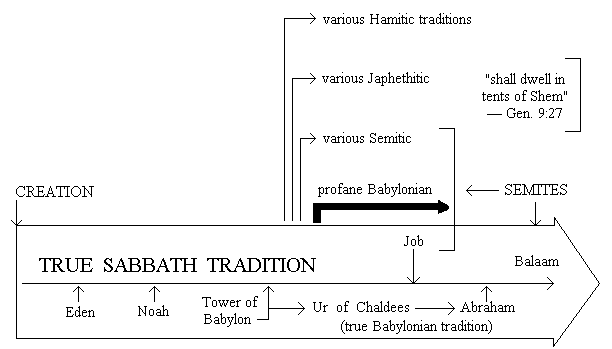
in the life of Job Job was a religious man, and, together with Noah and Daniel, was regarded as exemplary in this respect by Ezekiel (c. 14:14, 20), who wrote of him many centuries later. Writing later still, in the Christian era, the Apostle James regarded him as a prophet and monument of patience (c. 5:10-11). Indeed, the book of Job itself, written by an unknown author, regards Job as a man "perfect and upright, and one that feared God, and eschewed evil"(c. 1:1). This being the case, in view of his nearness to the erstwhile great city of Babylon and its tower in respect both of time and of locality, the overwhelming presumption is that he kept the true sabbath, even as the profane Babylonians kept at least a perverted form thereof. Moreover, when his seven sons feasted and wined on certain set days (or sabbaths?!), the fact that Job sent to sanctify the seven, and continually (or: "all the days" — Job 1:5 marg.) rose early in the morning to offer burnt offerings for them in the event of their having sinned against God [by feasting and wining and desecrating the sabbath?!] (Job 1:4-6, 13; cf. n. 118), probably indicates sabbath offerings or sacrifices too118. "Now there was a day when the sons of God came to present themselves before the Lord" [which "day" Jamieson120 and Thompson121 consider to be the sabbath], "and Satan came also among them"119, and persuaded the Lord to allow him to test Job’s faith. So, to vindicate Job’s righteousness against the unfounded allegations of the devil, the Lord permitted Satan to destroy all Job’s children and all his possessions, and later still [after another such day similar to the first119] to afflict Job himself "with sore boils from the sole of his foot unto his crown". But when Job’s three friends heard of all this evil that had come upon Job, they "made an appointment together to come to mourn with him and to comfort him. And . . . they lifted up their voice, and wept; and . . . sprinkled dust upon their heads towards heaven. So they sat down with him on the ground seven days and seven nights . . ." (c. 2:11-13). Firstly, it is stated here that the three friends "made an appointment" to come and mourn with and comfort Job, the nature of which appointment patently involved their sitting with him on the ground "seven days and seven nights". This clearly implies their recognition of an appointed period of seven days and seven nights in duration, i.e. of the week (and hence of the weekly sabbath as its demarcator!). Hence it seems clear that the observation of the sabbath, after the destruction of the city and tower of Babel and the dispersion of the nations, had been carried into the territories of the Temanites, Shuhites and the Naamathites, at least in respect of the ancestors and descendants of Job’s three friends Eliphar and Bildad and Zophar respectively. Secondly, it is written that "they lifted up their voice, and wept; and . . . sprinkled dust upon their heads toward heaven". Here it is as though the three friends are silently entreating the Lord of the Sabbath to restore Job’s health and restful peace, or otherwise to put him out of his weary misery and take him unto his eternal sabbath rest. And thirdly, it is stated that: "they sat down with him on the ground seven days and seven nights". This certainly suggests the bond of fellowship of the believers, the communion of the saints, albeit in silence. It is possible that this phrase points back to the ancient communal observance of the sabbath, such as was seen when Noah and all his family (as then the total church militant in all the world) congregated together to bring an offering unto the Lord on the sabbath day. Perhaps the four friends sat from one sabbath to the next, or perhaps they waited for the hebdomadal crisis in Job’s illness, but however that may be, the phrase probably has some sabbatical connotation122. But Job’s suffering became unbearable. "Why died I not at the womb?", he complained, "for now should I have lain still and been quiet . . . then had I been at rest.., there the weary be at rest. There the prisoners rest togther . . . And where is now my hope? . . . our rest together is in the dust"123. Yet in the very midnight of his suffering and restlessness, his faith in the Lord of the Sabbath rest breaks through! "I know that my Redeemer liveth", He exults in triumph, "and that He shall stand at the latter day upon the earth: and though after my skin worms destroy this body, yet in my flesh shall I see God" (c. 19:25-26). Ultimately, in spite of allegations by Job’s three friends that he must have sinned against God to have merited all his suffering, God vindicated his servant and restored him to health. Whereupon "the Lord said to Eliphaz the Temanite: ‘My wrath is kindled against thee, and against thy two friends; for ye have not spoken of Me the thing that is right, as My servant Job hath. Therefore, take unto you now seven bullocks and seven rams, and go to My servant Job, and offer up for yourselves a burnt offering" (Job. 42:7-8). It will be remembered that the offerings of Adam, Abel and of Noah were probably all brought on the seventh-day sabbath. In this offering of Job’s three friends, the concept of seven is very striking in the objects which the Lord expressly stipulated were to be burned, namely seven bulls and seven rams and it is very possible that this too was a sabbath offering124. The relationship of these various post-dispersional sabbath traditions to one another may perhaps be represented as in the following diagram: DIAG. XIII — AFFINITY OF VARIOUS SABBATH TRADITIONS CREATION
|
||||||||||||||||||||||||||||||||||||||||||||||||||||||||||||||||||||||||||||||||||||||||||||||||||||||||||||||||||||||